Armavir sights
- Churches
Etchmiadzin Cathedral
Etchmiadzin Cathedral (Armenian: Էջմիածնի մայր տաճար, Ēǰmiatsni mayr tačar) is the mother church of the Armenian Apostolic Church, located in the city of Vagharshapat (Etchmiadzin), Armenia. According to most scholars it was the first cathedral built in ancient Armenia, and is often considered the oldest cathedral in the world.
The original church was built in the early fourth century[33]—between 301 and 303 according to tradition—by Armenia’s patron saint Gregory the Illuminator, following the adoption of Christianity as a state religion by King Tiridates III. It was built over a pagan temple, symbolizing the conversion from paganism to Christianity. The core of the current building was built in 483/4 by Vahan Mamikonian after the cathedral was severely damaged in a Persian invasion. From its foundation until the second half of the fifth century, Etchmiadzin was the seat of the Catholicos, the supreme head of the Armenian Church.
Although never losing its significance, the cathedral subsequently suffered centuries of virtual neglect. In 1441 it was restored as catholicosate and remains as such to this day.[34] Since then the Mother See of Holy Etchmiadzin has been the administrative headquarters of the Armenian Church. Etchmiadzin was plundered by Shah Abbas I of Persia in 1604, when relics and stones were taken out of the cathedral to New Julfa in an effort to undermine Armenians’ attachment to their land. Since then the cathedral has undergone a number of renovations. Belfries were added in the latter half of the seventeenth century and in 1868 a sacristy was constructed at the cathedral’s east end.[2] Today, it incorporates styles of different periods of Armenian architecture. Diminished during the early Soviet period, Etchmiadzin revived again in the second half of the twentieth century, and under independent Armenia.[2]
As the main shrine of Armenian Christians worldwide, Etchmiadzin has been an important location in Armenia not only religiously, but also politically and culturally.[35] A major pilgrimage site, it is one of the most visited places in the country.[36] Along with several important early medieval churches located nearby, the cathedral was listed as a World Heritage Site by UNESCO in 2000.
Saint Hripsime Church
Saint Hripsime Church (Armenian: Սուրբ Հռիփսիմե եկեղեցի, Surb Hřip’simē yekeghetsi; sometimes Hripsimeh)[6][7] is a seventh century Armenian Apostolic church in the city of Vagharshapat (Etchmiadzin), Armenia. It is one of the oldest surviving churches in the country. The church was erected by Catholicos Komitas to replace the original mausoleum built by Catholicos Sahak the Great in 395 AD that contained the remains of the martyred Saint Hripsime to whom the church is dedicated. The current structure was completed in 618 AD. It is known for its fine Armenian-style architecture of the classical period, which has influenced many other Armenian churches since. It was listed as a UNESCO World Heritage Site along with other nearby churches, including Etchmiadzin Cathedral, Armenia’s mother church, in 2000.
Church of Shoghakat
The Church of Shoghakat (Armenian: Շողակաթ եկեղեցի; meaning «drop of light» because of the ray of light that came down from heaven upon Hripsimé’s martyrs) was erected in 1694 by Prince Aghamal Sorotetsi during the reign of Catholicos Nahabed I in the city of Vagharshapat (Etchmiadzin), in Armenia‘s Armavir Province.
Saint Gayane Church
The Saint Gayane Church (Armenian: Սուրբ Գայանե եկեղեցի; pronounced Surb Gayane) is a 7th-century Armenian church in Vagharshapat (Etchmiadzin), the religious center of Armenia. It is located within walking distance from the Etchmiadzin Cathedral of 301. St. Gayane was built by Catholicos Ezra I in the year 630. Its design has remained unchanged despite partial renovations of the dome and some ceilings in 1652.
Gayane was the name of an abbess who was martyred with other nuns by Tiridates III of Armenia in the year 301, and subsequently made a saint of the Armenian Apostolic Church.[1][2]
In 2000, Saint Gayane Church was listed in the UNESCO World Heritage Sites along with historical churches of Vagharshapat.
2. Zvartnots Temple
Located 5 km from Echmiadzin is one of the brightest landmarkst of medieval Armenian architecture –the magnificent Zvartnots Temple constructed in the 7-th century. Unfortunately, like the majority of other ancient Armenian temples, Zvartnots has survived only in ruins since it was completely destroyed by powerful earthquake in the 10 th century. But even the ruins of this temple give us the idea of its rare and majestic beauty.
It used to be a three-storied round temple of 49 m height consisting of three differently sized cylinders put against on top of each other crowned with a spherical pyramid-shaped cone. The temple stood on a platform surrounded by stepped pedestal which has partially survived. The temple reminds a cross put into a circle. This cross was the basis of the internal space of the temple. The entire structure was supported by four 20-m mighty columns. The round internal space was surrounded by a two-level gallery. The second level of the church was through from the three sides and its walls rested on six powerful columns. The entire composition was crowned with a tall many-sided dome. Five entrances led to the temple.
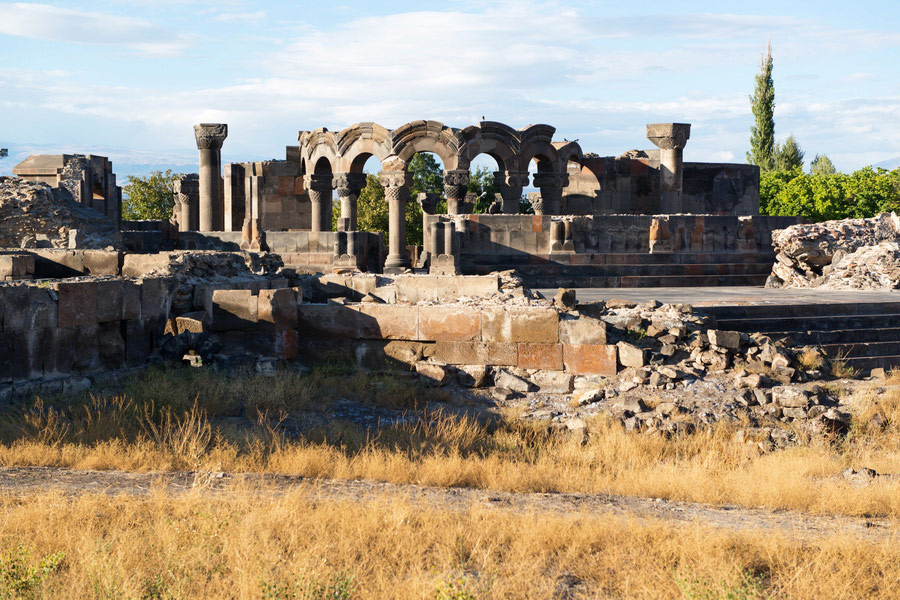
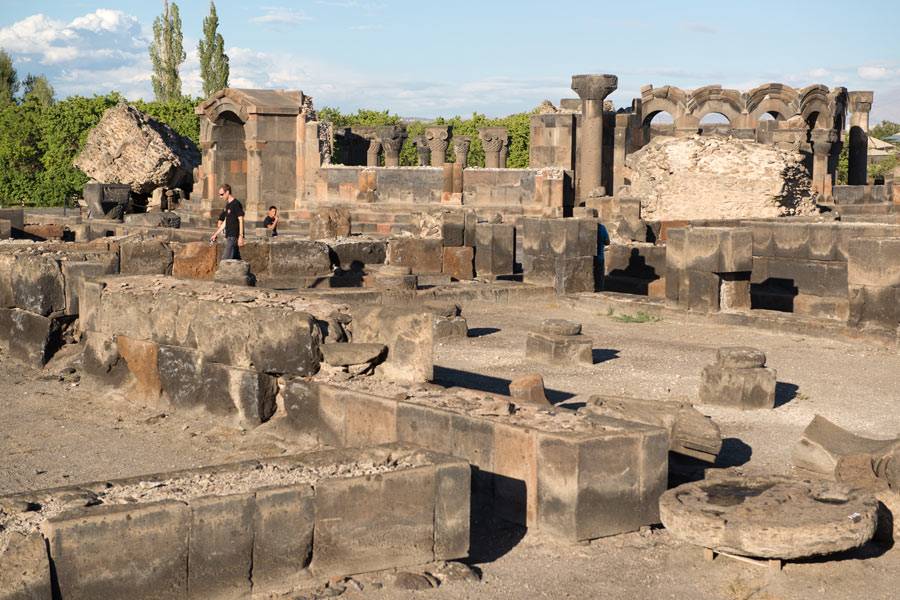
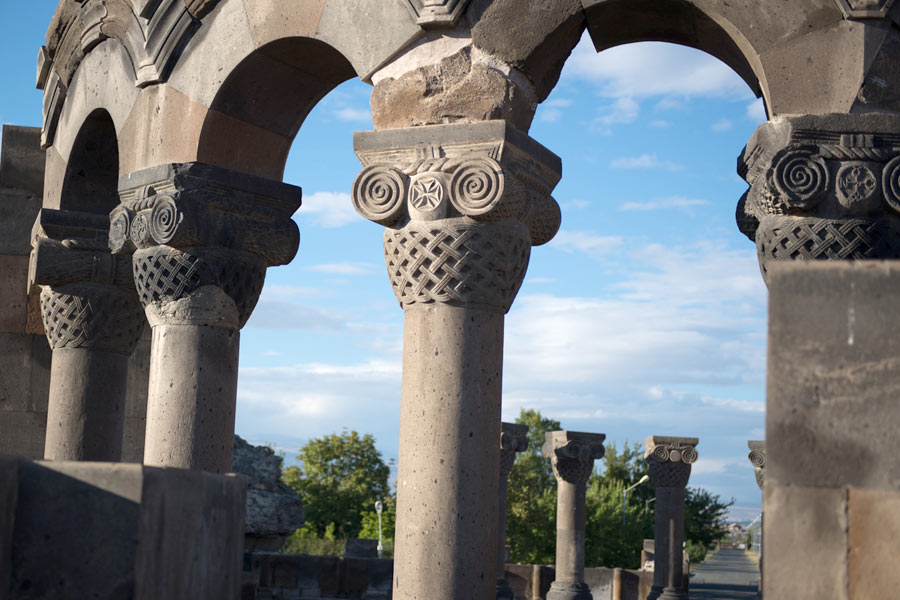
From top to bottom the temple was decorated with the magnificent stone carving. The intricate ornament framed the eaves and braided the window apertures. The temple’s walls were decorated with grapevines, branches of a pomegranate, the finest geometrical patterns. The rich mosaic adorned the temple’s walls. Zvartnots was also decorated with waist-length sculptures of people. Free natural poses; the detailed elements of clothes, almost portrait-like cut faces give us the idea of how medieval Armenians looked like.
The construction of Zvartnots Temple (the Temple of Watching Forces) began in 641-643 and intermittently continued for twenty years until 652.
Zvartnots had stood for more than three hundred years and around 930 was destroyed by the earthquake. As researchers found the architect of the temple did not manage to transfer the entire weight of the top levels on the four powerful pylons which served as the main supports; as the result the part of the load was applied on the arches and the temple’s vaults. It was the weakness of the building’s design and the mighty earthquake tore it apart…
With time the huge hill was formed on the place of the temple with the remains of the four pylons. It was only in the early 20 th century that the famous Armenian architect Toros Toramanian tried to start the restoration works in Zvartnots.
Today Zvartnots territory is the archaeological reserve and the museum which was opened in 1937 where it is possible to see the models – possible variants of the temple reconstruction, and numerous sculptural fragments impressive in their sizes. Huge stone slabs with the figures cut in them, the sundial, clusters of grapes and pomegranates have survived in good condition.
The ruins of Zvartnots Temple are designated by UNESCO as World Heritage Site.
Sardarapat Memorial
Sardarapat Memorial is a memorial complex to the Battle of Sardarabad located in the village of Araks, in the Armavir Province of Armenia, 11 kilometers southwest of Armavir town.
History- In the early 1960s, initiatives in honor of the battle were conceived, one of the main authors of which was the First Secretary of the Communist Party of Armenia Yakov Zarobyan, who pointed to an interest in perpetuating historical events in the Armenian diaspora. In 1964, Zarobyan’s report was sent to the Central Committee of the CPSU, after which Moscow gave its consent for the project.[2] In 1966, a change in the leadership of Soviet Armenia took place, during which Zarobyan was replaced by Anton Kochinyan, under whom, the construction of the memorial was carried out.[3][4] In 1968 during the commemoration of the 50th anniversary of the Battle of Sardarapat that took place on May 22–26, 1918 a memorial park was laid out on the spot of the battlefield.[5] In 1969, the Sardarapat Memorial Complex was nominated for the USSR State Prize. In the early 1980s, the leaders of the Armenian SSR, the Georgian SSR and the Azerbaijan SSR (Karen Demirchyan, Eduard Shevardnadze and Heydar Aliyev respectively) visited the memorial complex as part of the session of the Military Council of the Transcaucasian Military District. The presence of Azerbaijan’s Aliyev at the memorial is notable in that it marked the only time an Azeri leader paid respects to Armenia’s war dead.
4.Machanents Tun Tourism and Art Center in Etchmiadzin
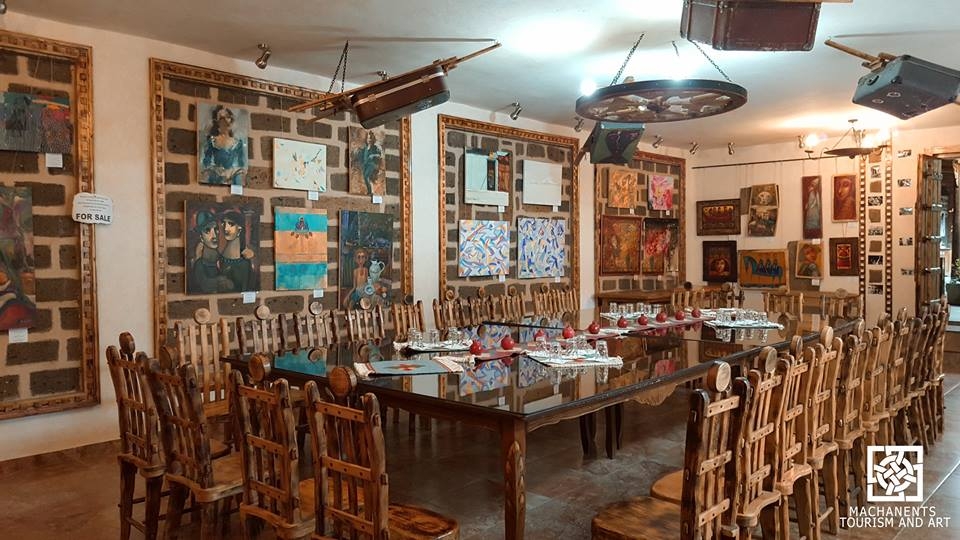
Machanents Tun is one of the most popular and favourite place in Etchmiadzin. It is the combination of the culture, tourism, art, amazing nature and so on. Let’s learn more about this heavenly place.
«Tourism is the science of the nations’ cultures’ communication».
G. Machanents
These are the holy words which were the base for the birth of Machanents Tourism and art centre. Many people from all over the world visit this heavenly spot to enjoy themselves after the craziest routine of the daily life, tourists like to admire the fantastic culture and the artworks.
Machanents Tun has become the “roundtable” where people of all nations meet and share their culture and art, others have the greatest opportunity to admire these very artworks
 Մերի Հովեյան